It’s hard to underestimate the scale and complexity of our global challenges, particularly as the world’s population continues to grow. This can seem overwhelming, but can, in fact, be a powerful motivator to rethink the role of higher education and the ways that our institutions can be productive, disruptive forces for positive change and progress.
This begins with the notion that universities should take responsibility for the betterment of society; that we can and should be measured by the impact that we have on the public good. It is no longer sufficient to simply excel academically.
Education should move beyond singular academic disciplines as the point of focus and towards multidisciplinary programmes and schools capable of understanding and solving complicated real-world problems. Just understanding those problems is not good enough.
Why shouldn’t engineers work with social scientists, for example? Why not encourage arts students to intersect with economists or public policy professionals? Emerging fields are benefiting from the integration of the sciences – biology, chemistry, physics, technology and more. This is not only intellectually engaging, it also positions us to ask new and better questions to find critical answers.
Why not create schools focused on exploration or sustainability and outcomes, or other new conceptualisations for science itself?
At the core of this push is the belief that our capacity for learning and adaptation will define the progress that we make. That’s why we want to expand the population of lifelong “master learners”, students, indeed citizens, who are capable of thinking critically and who possess a breadth of knowledge to meaningfully engage the shifting challenges of a rapidly changing world.
We are ambitious in this pursuit. The more we can produce master learners who are thinking beyond narrow academic pursuits and more broadly dedicated to improving society, the more we can have a major impact on the outcome of humanity. But making this happen also requires expanding access – prioritising inclusion over selectivity.
At Arizona State University, a public research university, we operate on the premise that identifying and engaging talent from every neighborhood – and, ultimately, every corner of the world – makes us better prepared to confront grand challenges, redress social and economic inequalities, address shortages of educated workers and dreamers, and increase prosperity. Rather than pursue the time-worn and elitist model that presumes world-class learning can be derived only by limiting opportunity, we are dedicated to demonstrating that access and excellence can go hand-in-hand.
This is not without hurdles, which is why we emphasise innovation throughout the university, rethinking the structure of departments, emphasising multidisciplinary centres and schools that demand fresh thinking to succeed, and employing new technologies to increase the ways that students can learn. In turn, our expanding population of qualified students pushes us to pursue innovations to accommodate their needs and help them achieve their potential.
Our E-Advisor tool, for example, helps students stay on track and make progress towards their degree, improving our four-year graduation rate by 20 percentage points since 2002, with an increasingly diverse student demographic. Our use of adaptive learning software allows maths professors to identify whether students are absorbing new concepts, then work with them to close gaps that may cause them to stumble when they move on to more demanding courses.
Our web-based electrical engineering programme, the first accredited degree of its kind in the US, makes it possible for digital learners to perform lab work on their laptops – and watch (and re-watch) professors’ video presentations to raise their comprehension levels. We have found that on-campus students create hybrid digital and classroom experiences to suit their learning, raising the chances that they will meaningfully engage and succeed.
But as important as these tools and techniques are driving innovation and expanding opportunity. No one institution can do it alone. As useful as competition can be in the battle for students, faculty and research funds, too often we limit our capacity for shared impact.
The new PLuS Alliance, involving Arizona State University, King’s College London and the University of New South Wales, showcases this commitment to collaboration. Involving more than 60 jointly appointed faculty members at the start, this tri-continental partnership aims to tackle real-world challenges involving sustainability, global health, social justice, and technology and innovation. This multidisciplinary endeavour allows us to extend the range and depth of brain power by tapping into qualified learners from around the world.
We cannot say with certainty what the outcome will be. But the more fruitful we are in constructing an inclusive innovation ecosystem, the more we have the chance to surmount barriers and achieve results not yet imagined. Getting there requires letting go of the static model based on exclusivity and tradition, encouraging faculty to think and act beyond the confines of their academic disciplines, and continuously assessing our organisational design and the ways knowledge is produced.
While we may not know the eventual results, we can be sure that engaging with other institutions around the globe increases our prospects for transforming the planet.
Michael M. Crow is the president of

When the Nashville-based American musician Ben Rector made an appearance at Mercer University in the southern state of Georgia, more than a third of the 3,000 students showed up.
They heard his chart-topping pop rock – and an appeal from him that they vote.
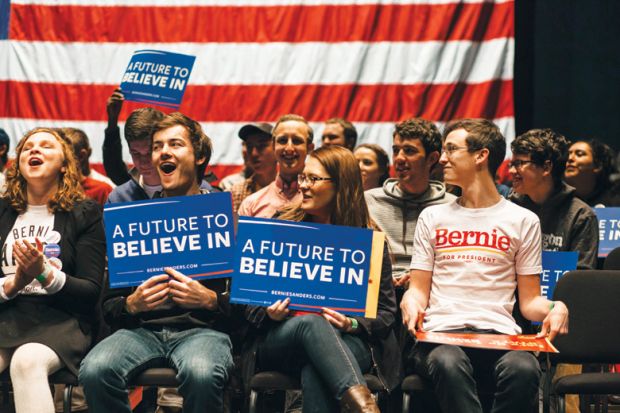
In a US presidential election year with candidates talking about such issues as tuition costs and student debt, and with huge numbers of young people showing up at rallies and demonstrations, activists are working frantically to convert this energy into votes.
Joey Wozniak – a student at Mercer who leads efforts to get his peers to vote, including bringing the concert to the campus – said that there was excitement about the election among the student body. “Whether or not that translates into higher youth voter turnout, I don’t know,” he added.
To judge from history, the odds are against it. In the 2012 presidential election, only 45 per cent of university students voted, according to the National Study of Learning, Voting, and Engagement, based at Tufts University. That was lower than overall turnout, which was 54 per cent.
One reason for the low participation might be that this generation of undergraduates has grown up almost entirely in a time of partisan intransigence and political dysfunction.
However, this year may be different in terms of student political participation, some observers say.
In state primary elections to select a nominee, students have been voting in large numbers – especially on the Republican side. In those contests, students have disproportionately supported opponents of Donald Trump, who is nevertheless the party’s presumptive presidential nominee.
“There is a contingent of young people coming out just to vote for anyone but Trump,” said Kei Kawashima-Ginsberg, director of the Center for Information and Research on Civic Learning and Engagement at Tufts.
On the Democratic side, students have given their votes overwhelmingly to Bernie Sanders over Hillary Clinton, in some cases by a margin of four to one.
“There is a sense of ownership among young people of the bigger issues [Mr Sanders] represents,” such as climate change and income inequality, Dr Kawashima-Ginsberg said.
But students have not needed party organisations to stimulate their involvement. In a year of massive demonstrations on campuses about issues such as racial diversity, they have become emboldened to act without prompting.
When Mr Trump planned a rally in Chicago, for example, students joined other activists in using social media to organise a protest so big that it forced him to cancel the appearance.
Considering that they already seem to dislike Mr Trump, and that Mr Sanders is unlikely to be the Democratic candidate for president, Dr Kawashima-Ginsberg said that “the risk is that the current parties, both Democrat and Republican, really have alienated many young people”.
But Mr Wozniak, who will have to repay loans of $25,000 (£17,330) taken out to help pay for his education, said: “We have not had issues that directly affected us addressed on this large a scale before.
“This is the first election that someone is looking at students and saying, ‘Wake up. You’re being affected over and over again, and you’re not translating that to the polls.’ People aren’t going to listen unless we work within the system.”
He and others at Mercer have organised a contest among the universities of the Southern Conference – an athletics league whose members compete in basketball, American football and other sports – to see which can do the most to increase voting among its students.
At California Polytechnic State University, students made a music video as part of a get-out-the-vote campaign, set to the tune of the Iggy Azalea hip hop hit Fancy. “Students, voice your vote and let the whole world hear it,” goes the rap.
Another organisation, TurboVote, uses technology to help tech-savvy students register on time, deal with the often-complicated process of voting, and remind them when the polls are open.
“This is a problem that technology can solve,” said TurboVote spokesman Brandon Naylor.
Some universities themselves, which are increasingly at the mercy of local, state and federal authorities for everything from building permits to funding, also recognise the value of having their students vote, although public institutions are forbidden from being partisan.
One, Montclair State University in New Jersey, declared its own voting district to make it easier for its students to cast their ballots.
Those kinds of logistical issues have a surprising impact.
“One of the things you’re fighting with college students is getting them to give their time for anything,” said Adam Reynolds, a student voting activist at the University of Chicago who helped arrange for buses to take classmates to the polls in the state primary elections in March.
But he is optimistic that students this year are more motivated than ever to vote.
“We’ve been presented with a series of options that scare people,” Mr Reynolds said. “And often fear will get people to go out and do things.”
 Much criticism has been directed to the criteria used in rankings and other assessments, based on the argument that universities are different to one another and therefore need to be assessed on a range of categories that recognize distinct strengths.